Collecting Effective UI/UX Feedback: Revision
| Project Scope: Entrepreneurship, Product Design, Product Management
| Project Date: Nov 2019 - Jan 2021
| Collaborators: Lucy Cheng (co-founder & business dev), SWE team



Project Revision was born out of a weekend startup bootcamp called AccelerateHer, where my co-founder and I met, ideated and pitched our product, and placed 1st. We identified a problem that collecting genuine, relevant, interpretable customer feedback on a website’s UI/UX was very difficult. By making our point and suggesting a solution, we got accepted to Berkeley SkyDeck’s HotDesk program where were provided funding and mentorship.
As co-founder and product manager, I initiated, ideated, and designed the product through market and user research, and led a team of 3 engineers to explore feasible technologies.

Introduction
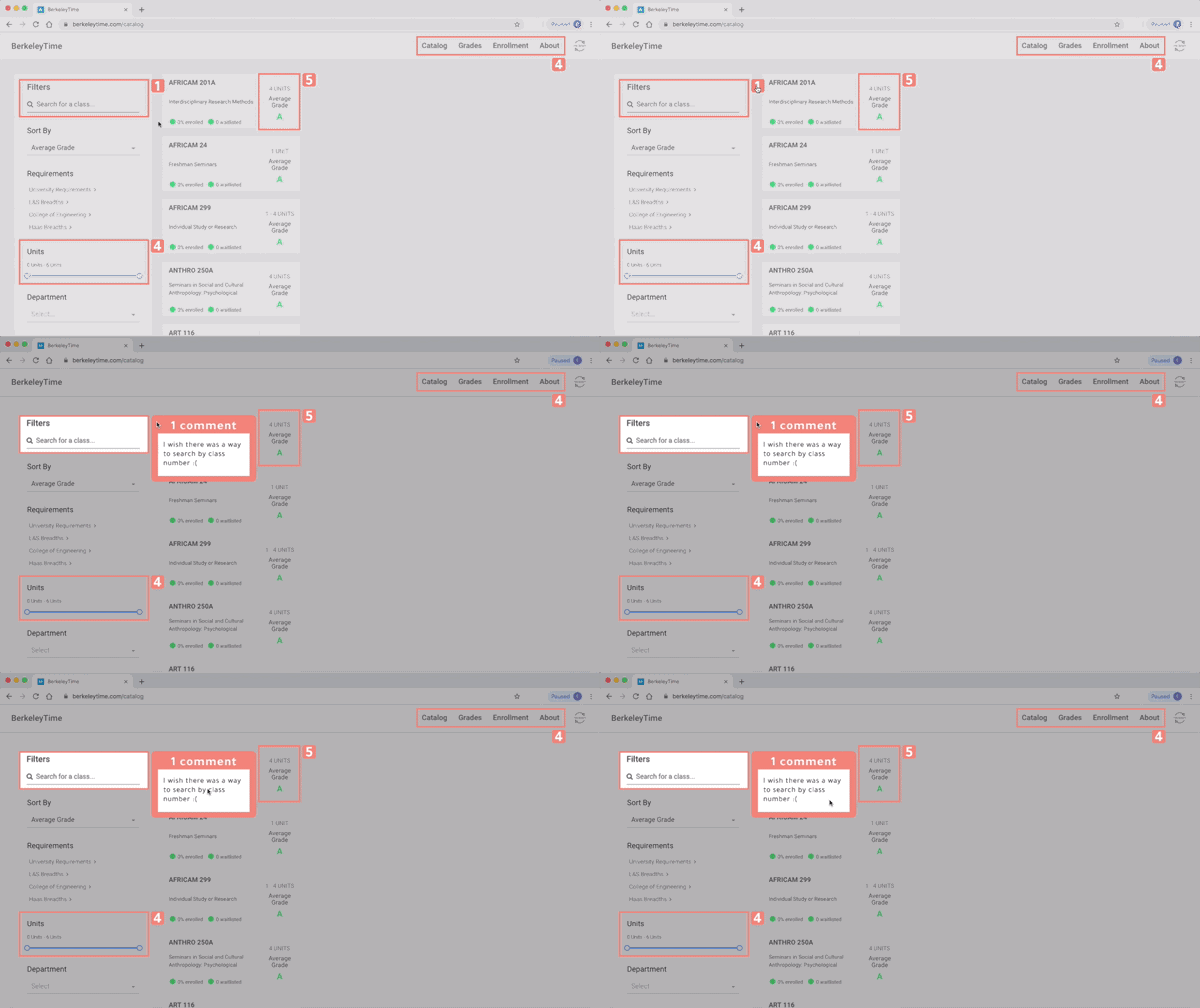
Many companies spend thousands of dollars on perfecting the best platform and experience for their customers, only to find that many users are unsatisfied, encountering inconvenience and having trouble navigating around the platform. This is why many companies implement customer feedback systems. Whether it's through the app store, customer support team, community site, or other review tools, companies spend extra dollars trying to collect authentic, relevant feedback from their users. However, when the feedback is design- or experience-related, it's often hard to describe the exact location of the inconvenience in words, and not only does it take more effort for customers to give feedback, it takes more time for companies to digest and analyze every qualitative comment.
I co-founded Revision with Lucy to solve this problem. How can we collect feedback that is convenient for website users, yet relevant and authentic for companies to implement and improve their platforms? How can we quantify qualitative feedback on the design?
1. User Research
When we first acknowledged inconvenience in both giving and receiving customer feedback, we started by literally walking out of the room and talking to random people we encountered. Most people we talked to were students who spent a good majority of their day online. We asked them about their online shopping and web surfing experiences in general, asking them about their web usage patterns and decision making processes, along with their experience with customer reviews. What makes you purchase a certain product online? What drives your decisions? How do you feel about leaving customer reviews?
We found that many customers feel inconvenience while surfing online, either with the product they want to purchase or their experience with the platform; however, unless they are incentivized with a price, whether its monetary or has some type of gamification involved, they will not put in the effort to submit a customer review. The problem here is, if they need to be incentivized by something other than inconvenience itself, how can we ensure that feedback collected by companies are genuine and relevant?
CONVENIENCE
First and foremost, giving feedback from the user's point of view has to be convenient. No user goes miles out of their way to give feedback to a company. Plus, feedback is best when discomfort is freshest - given right as users are encountering the problem.
RELEVANCE
The feedback should be accurate and relevant to businesses. It should not be incentivized with any monetary or exclusive benefits. In order for the feedback to be truly accurate, the only incentive for the user to give feedback should be discomfort from using the company's platform.
2. Market Research
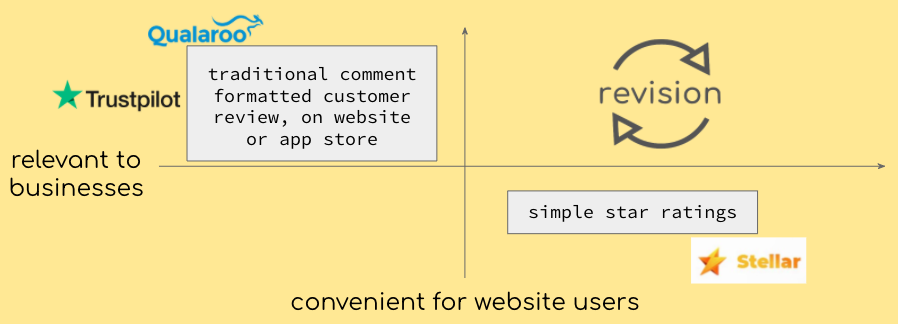
With what we learned from user interviews, we researched the market and competition, focusing on tools and services for collecting customer reviews. There were platforms that focused on making feedback easy to collect, such as star ratings or number ratings. Meanwhile, there were others that made sure feedback was relevant to businesses, usually in the form of surveys and text comment boxes. Here, we saw a hole in the market for customer review tools that combined the two, convenience for website users and relevance for businesses implementing the feedback.
We also contacted several businesses, asking about their current customer feedback method. Most companies replied that they had a separate team that worked with customer support, that looked at each comment and delivered insights to the designers and developers. We felt that there could be a cheaper and more efficient method that could easily filter and group each feedback.
3. Product Design
With a vision of how such tool would work in mind, I created several sketches.
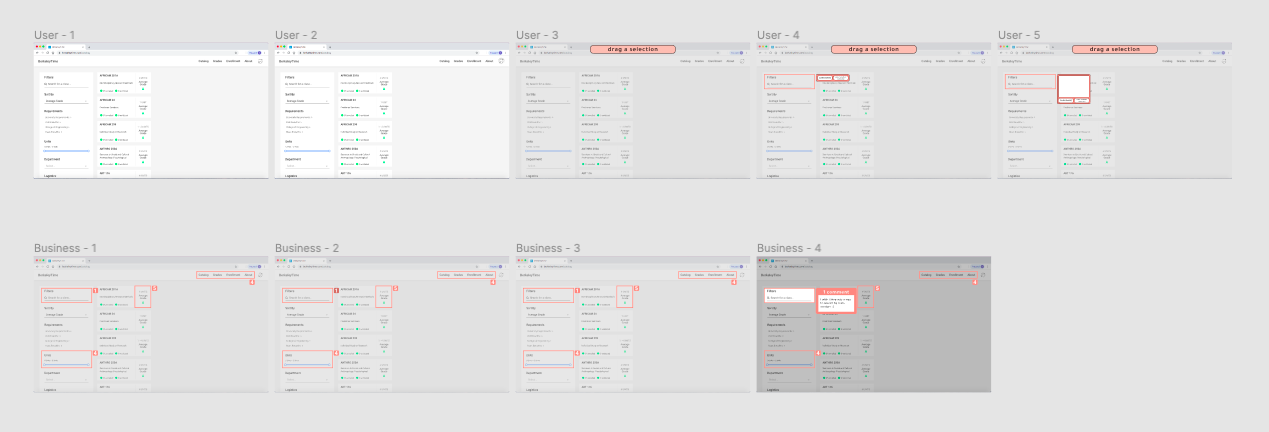
Next, I created and refined the prototype on Figma, one of the view that website users would interact with, and another that the business and website managers would see.
Takeaways
Through two startup accelerator programs, AccelerateHer@Berkeley and Berkeley SkyDeck, we were able to meet advisors as well as recruit team members who were passionate about our product. With more members and resources, we created a business development team, which my co-founder Lucy led, and a software engineering team which I led.
For several months, 4 software engineers and I experimented with various tools and methods for implementation. Through the initial startup weekend and mentorship and advising meetings, I learned:
Build a Tylenol (product that solves a problem), not a vitamin (a nice-to-have).
Listening to many voices leads to patterns and insights. Through cold-calling and emailing 30+ potential customers, we were able to find a central theme in the inconvenience and difficulty in collecting accurate, relevant customer feedback.
Break down a project into mini pieces and consult experts. With no prior experience building software other than simple websites and apps, my mind went blank when trying to build software like the prototype I had created. However, once I consulted my engineers as well as industry experts, I saw that it was essentially a combination of different approachable technologies.
There are many ways to solve one problem — with a motivation of creating a web overlay, we explored options between building a Chrome extension, creating an API plugin, or making a copy of the original website with our technology built onto it. As long as it aligns with the overall goal, the technology and usability can vary.
Start somewhere, then iterate. It doesn’t have to be perfect on the first try, because you can learn and adjust. Wrong progress is better than no progress!